
Twenty a Day — Adaptive DSE & GCSE Revision
by Uncredited
Every student already knows the advice: revise daily, target your weak topics, don't cram. Knowing it was never the problem. The habit apps that solved this for language learning all work the same way — a small daily hit, instant feedback, a streak you don't want to break — and nobody had built one properly for a syllabus the size of the HKDSE, where the exam is a year away and motivation runs out long before the paper does.
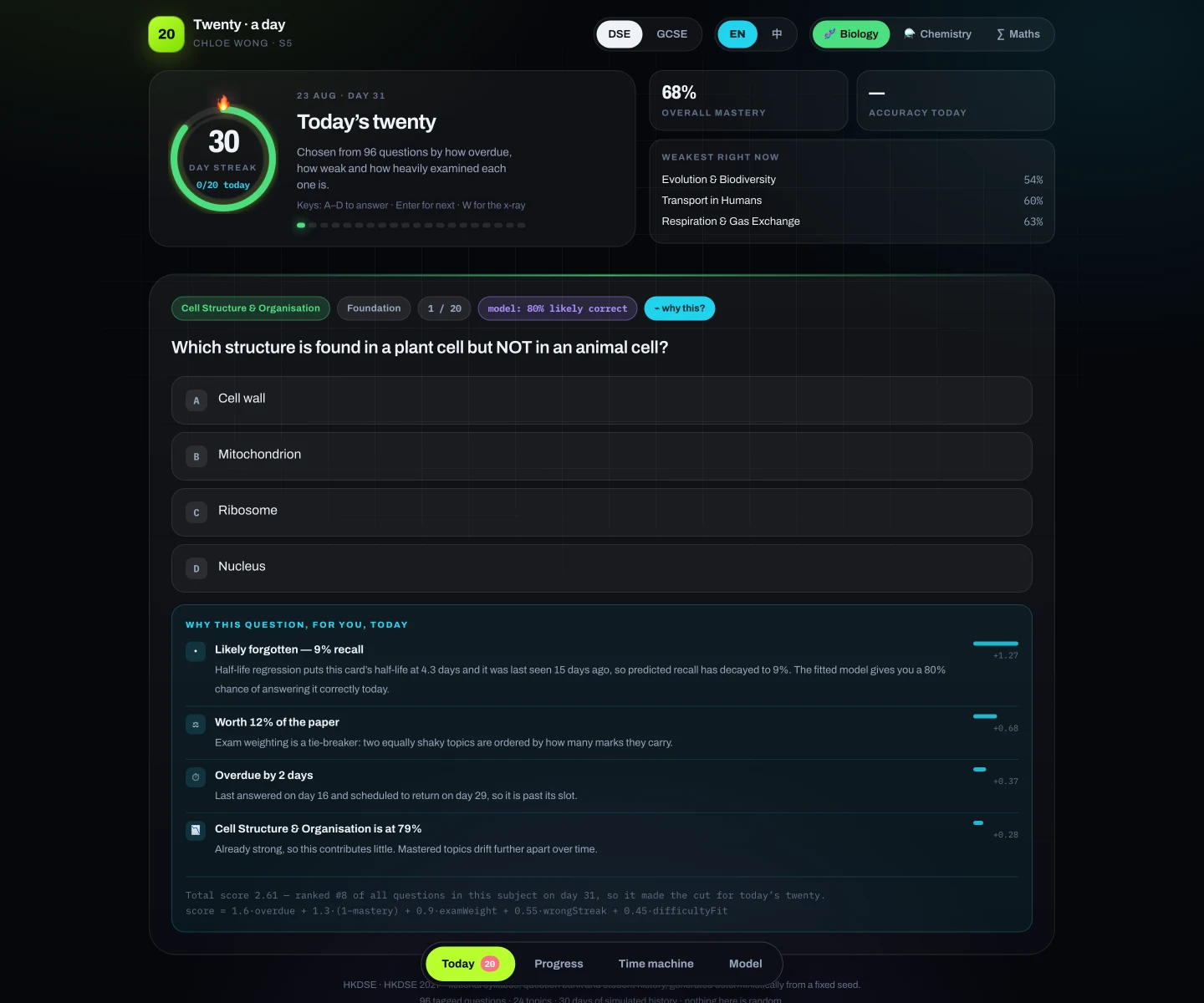
So this is twenty questions a day, drawn from a bank of 96 across 24 topics, with a streak and a mastery dashboard. The interesting part is what chooses the twenty.
A first version scored each question on a heuristic: how overdue it was, how weak the topic looked, how many marks it carries in the real exam. That heuristic had a flaw worth naming, because it is the flaw in most student-built quiz apps — it treated a lucky guess on a four-option multiple choice as evidence of knowing something. There is a 25% floor under every score and a running average cannot see it.
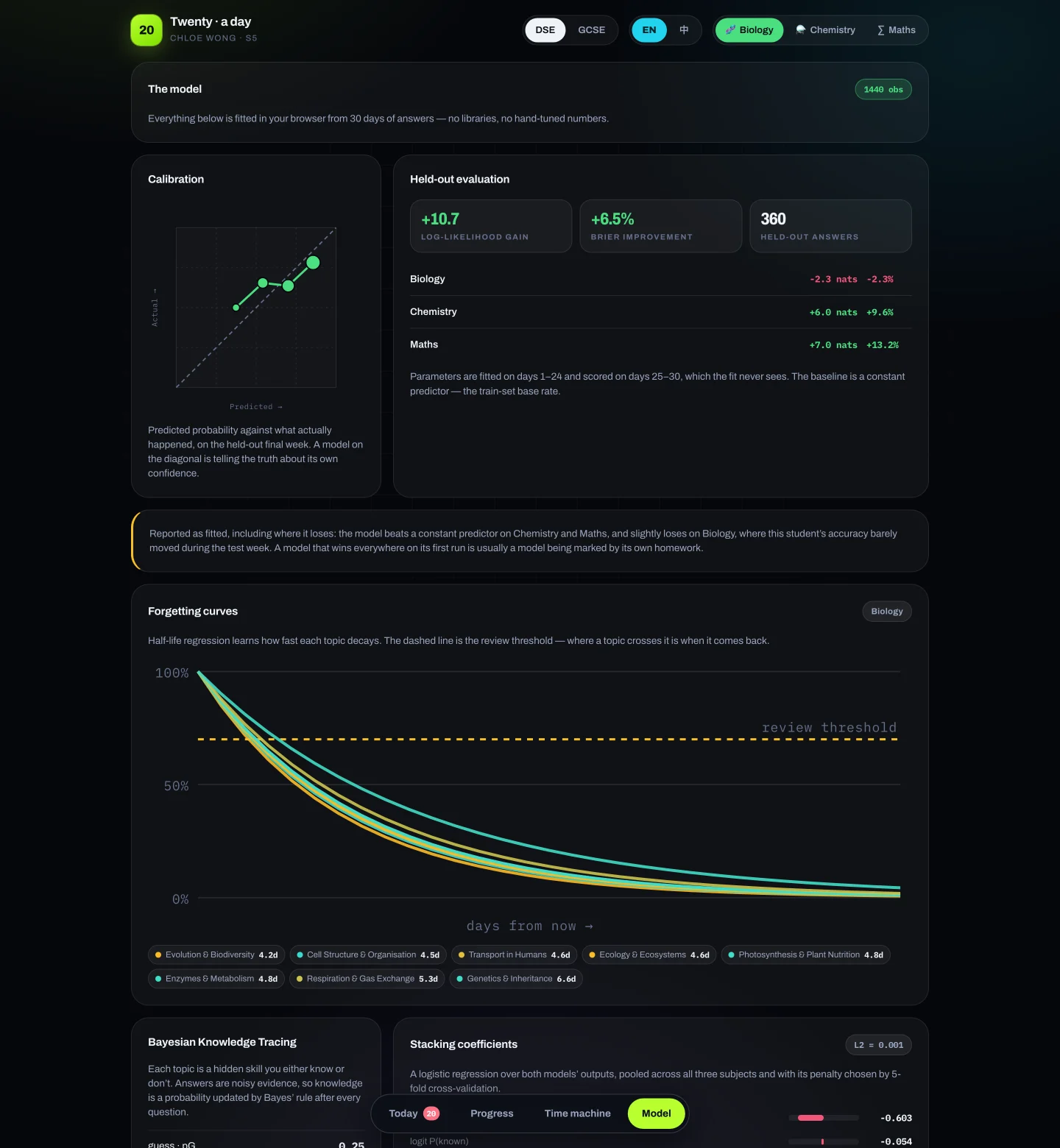
The fix was to replace the guesswork with two models that actually exist in the literature, both fitted in the browser from the student's own answer log with no libraries. Bayesian Knowledge Tracing (Corbett & Anderson, 1995 — the standard model in intelligent tutoring systems) treats each topic as a hidden skill you either have or don't, and updates the probability by Bayes' rule after every answer, with explicit guess and slip parameters so a fluke stops counting as knowledge. Half-life regression (Settles & Meeder, ACL 2016 — the model Duolingo published and uses) learns how fast each individual card decays from memory, by gradient descent, so the app can say a card's half-life is 4.3 days and its predicted recall has fallen to 9%. A logistic regression then stacks both models' outputs into a single calibrated prediction, with its regularisation penalty chosen by five-fold cross-validation rather than picked by hand.
Getting those models to behave was the real work, and most of it was refusing to accept a good-looking answer. Left unconstrained the fit converged on 'the student knows everything and simply slips a third of the time' — which fits the data and means nothing, because a 34% slip rate is not slipping, it is not knowing. Textbook BKT has no forgetting at all, so across thirty days every topic saturated at P(known) = 1 and the mastery view went flat, which for a revision app is precisely backwards. Guess, left free, climbed to 0.40 and quietly swallowed the student's genuine partial knowledge. Each of those is a known failure mode with a known fix, and the model only became meaningful once all three were applied.
The honesty is the point, and it is built into the interface. Parameters are fitted on days 1–24 and scored on days 25–30, which the fit never sees. Against a constant-predictor baseline the model gains 10.7 nats of log-likelihood and 6.5% Brier score across 360 held-out answers — winning clearly on Chemistry and Maths, and losing slightly on Biology, where this student's accuracy barely moved during the test week. That loss is displayed in the app rather than hidden, next to a calibration plot showing predicted probability against what actually happened. A model sitting on the diagonal is telling the truth about its own confidence, and a model that wins everywhere on its first run is usually a model being marked by its own homework.
All of it is visible to the student, not buried. Every question carries a 'why this?' x-ray that opens to show the scoring terms that put it in front of them today — predicted recall, exam weighting, days overdue, topic mastery — each with its numeric contribution and the question's rank out of the full bank. Those explanations are not written by hand; the scheduler emits them as a by-product of the same function that does the selecting, so the explanation cannot drift away from the behaviour. A thirty-day time machine scrubs the whole streak, watching the mastery heatmap move from red to green.
It runs in English and Cantonese — all 96 stems, all 384 options, and the model's own generated explanations — with the interface in colloquial Cantonese and the questions in Standard Written Chinese, which is how a Chinese-medium DSE paper actually reads.
More like this
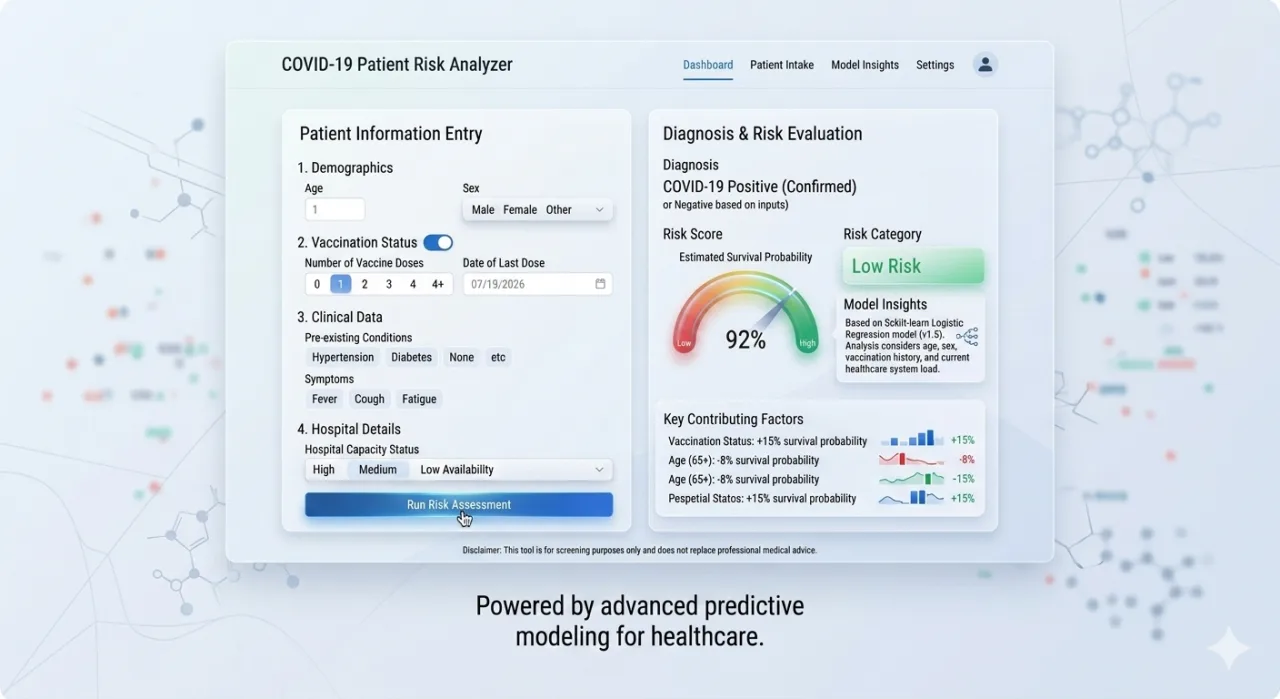
COVID-19 Survival Predictor
by Surina Shahani
A machine-learning model that estimates a patient's outcome from real-world factors — vaccine doses, age, sex, and how full the nearest hospital was at the time of care.

Life Predictor — What Does Your Future Hold?
by Simran Shahani
A playful prediction app powered by her own scikit-learn models — answer a handful of questions and get data-driven guesses at your future city, career, car and love life.

RetentionOS — Customer Churn Predictor
by Zach Tudor
A live logistic-regression model that predicts whether a customer is about to leave — move six real business inputs and watch the churn probability, feature impact and recommended action update instantly.